Agents suggest. People decide.
november drafts fast, but nothing reaches the public until a person has read and approved it (by default, someone other than its author), and every fact in it points back to the candidate's own words.
The path every piece takes
Rebuttals, explainers and posts all move through the same control points. Agents can draft, score and recommend at any step. They cannot approve, release, share or override: the platform refuses them.
Step 1
Submit
The author
Sends a draft to review. november scores it on arrival: how much of it is cited, how much an agent wrote, and the critic's KPIs with reasons.
Step 2
Approve
A second person, by default
Someone with an approve role. By default that is someone who neither wrote nor submitted the draft, so nobody approves their own work; a campaign of one can turn that off, and the switch is on the record.
Step 3
Release
A person, after approval
Only approved work goes public. This gate always blocks; there is no way around it.
Step 4
Retire
A person
Takes a published piece down. The record of what ran, and who decided, stays.
Grounded or silent
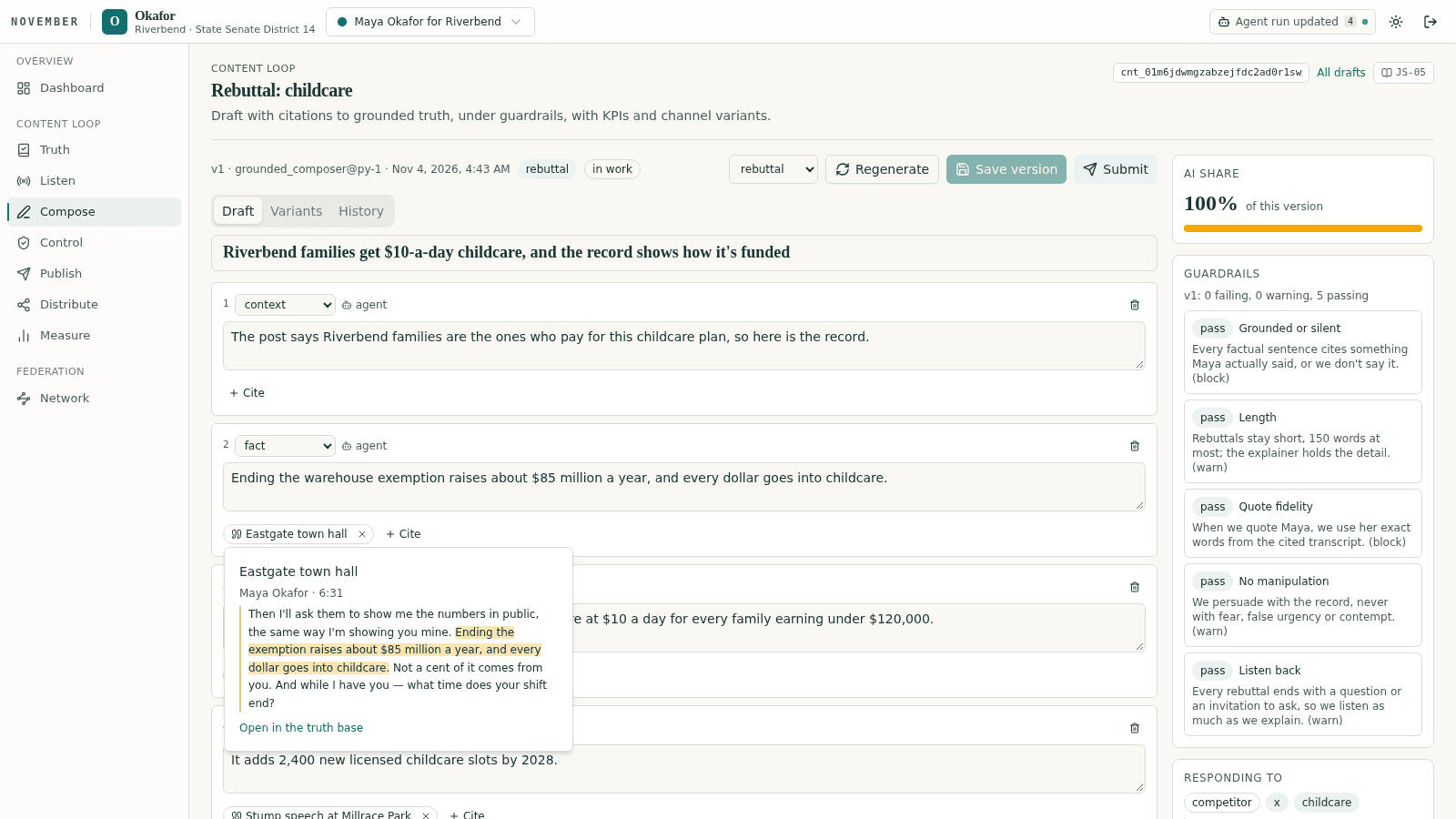
Every claim a draft makes cites the speech, town hall or meeting it came from. Reviewers open the citation and read the candidate's words in place. When the record has nothing to say, november says nothing.
AI share on every draft
Each version shows how much of its text an agent wrote and how much a person did, so a reviewer knows what they are reading.
Internal meetings stay internal
Staff meetings can inform a draft, but they are never cited in public. Published pieces and the explainer cite only public sources.
Guardrails written as the campaign's own principles
A campaign states what it will and won't do, in its own words, and decides which principles block a draft and which warn the reviewer. november checks every version against them.
- Grounded or silent
- Every factual sentence cites something the candidate actually said, or it isn't said.
- Enforcement: Blocks
- Quote fidelity
- When a piece quotes the candidate, it uses the exact words from the cited transcript.
- Enforcement: Blocks
- No manipulation
- Persuade with the record. No fear, no false urgency, no contempt.
- Enforcement: Flags for the reviewer
- Don't carry the attack's frame
- A position can rule out an opponent's figure or phrase. The critic flags a draft that repeats it.
- Enforcement: Flags for the reviewer
Scores that give their reasons
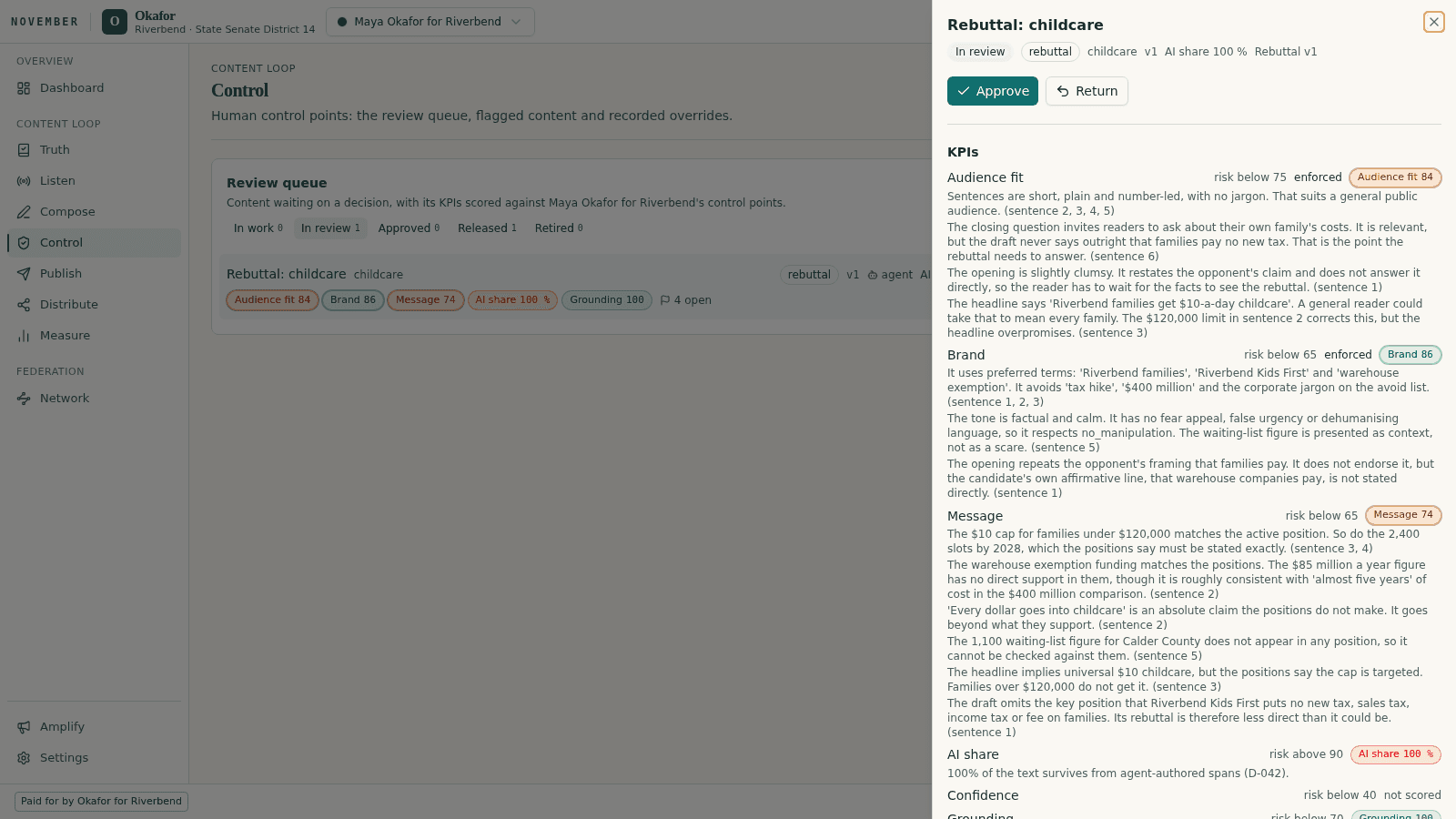
The critic scores each draft for audience fit, brand and message, and says why, sentence by sentence. A draft below an enforced threshold can't be approved unless a reviewer overrides it and writes down why.
Overrides are on the record
When a person approves past a failing score, november keeps the flag and the reviewer's note beside the version, where the next reviewer will see it.
An audit trail of every control point
Every submit, approval, return, release, retire and override records who acted, and for an agent, which person it acted for. The log is append-only.
Works without a model, and says so
Every agent in november has a mode with no AI at all: search, rules and templates. If a model is slow or unavailable, the campaign keeps working.
A result produced that way is marked as such, so nobody mistakes a rule for a judgement.
If governance pauses AI for a session, the console says so plainly and the work goes on by hand. november never retries around a pause.
Watch a draft go through review
The demo is a working console for a fictional race. Sign in, open a draft's citations, read the critic's reasons and approve it as a second person.