Campaigns that trust each other share what works.
When one campaign answers an attack well, a neighbour facing the same attack can take a copy, sources and all, and run it under its own name after its own review.
Every campaign stays sovereign
november connects campaigns without merging them. Each one keeps three things, whoever it works with.
Its data
A campaign never reads another campaign's records. Nothing leaves until a person offers it.
Its brand
A shared piece goes out under the receiving campaign's own brand, never the sender's.
Its approvals
A copy enters the receiver's own review. Its people decide whether it goes out.
How a share travels
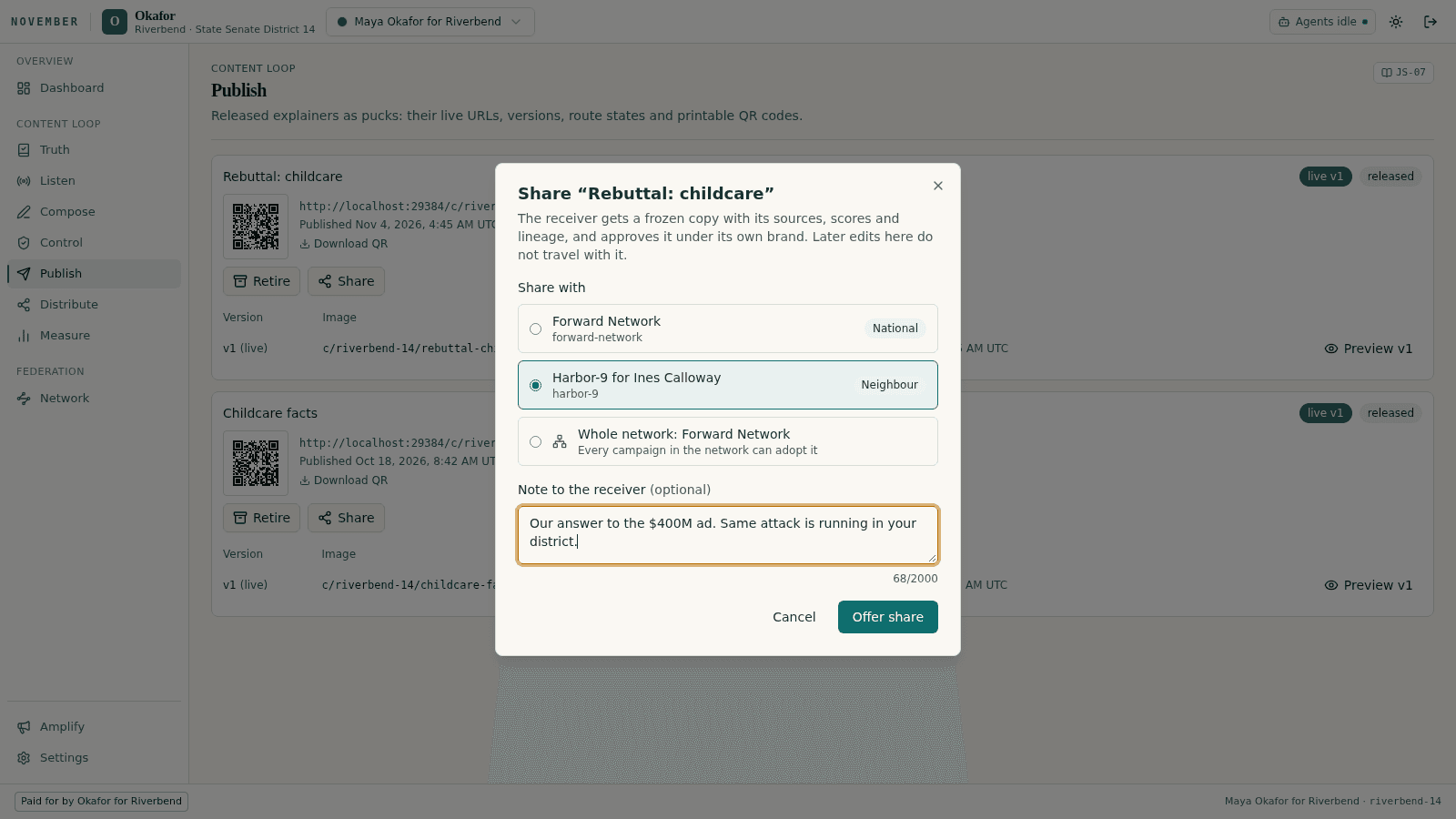
Sharing copies a piece, it never links to one. The copy carries where it came from, so every campaign can check the record behind it.
Step 1
Offer
A person picks a peer campaign or the whole network and adds a note. Agents can't share.
Step 2
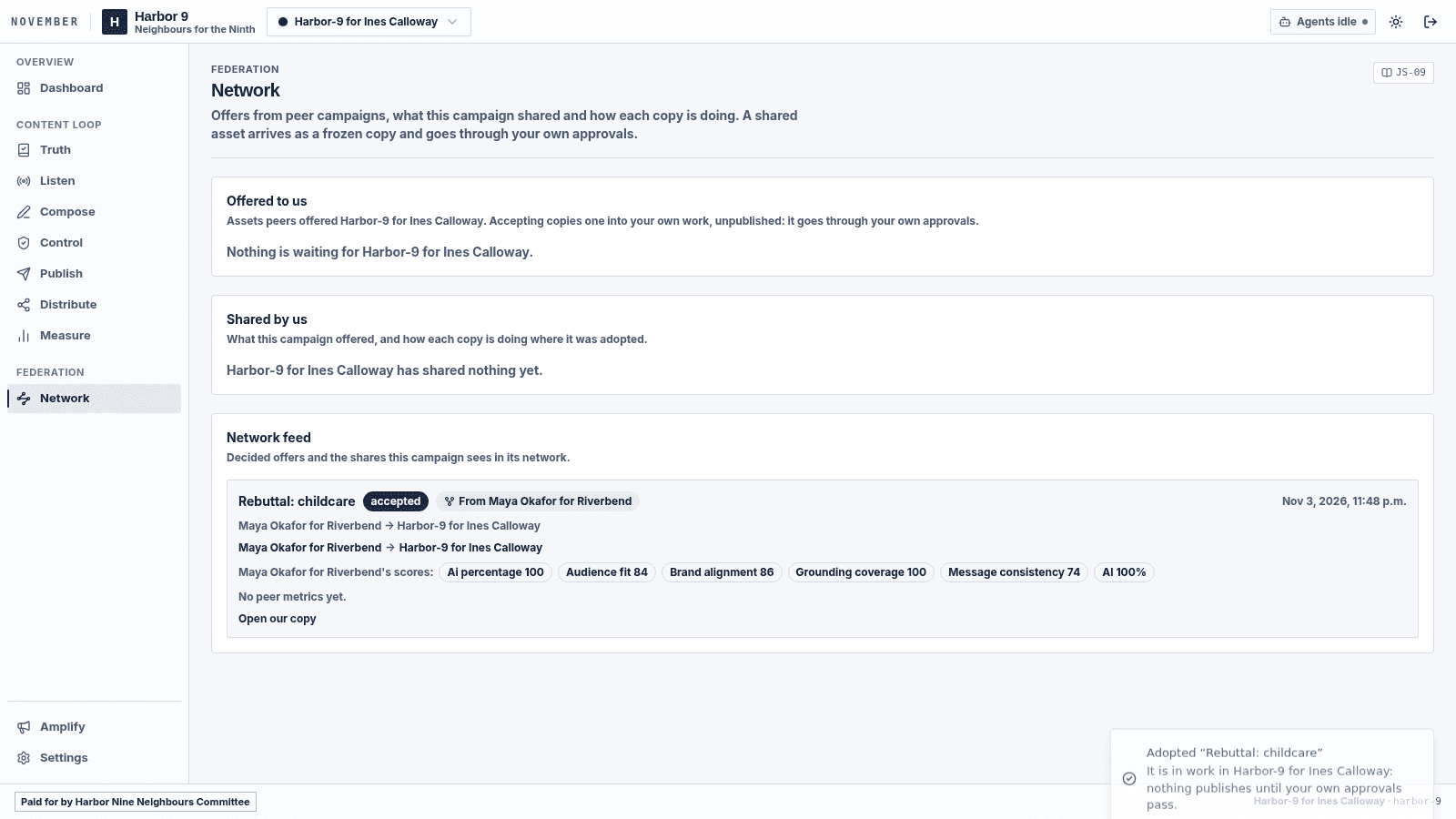
Accept
The receiver gets a frozen copy with its sources, scores and lineage. Later edits at the origin don't travel with it.
Step 3
Approve under its own brand
The copy lands in the receiver's work, unpublished, and goes through its own control points.
Step 4
Report back
The origin sees where its piece was adopted and how each copy is doing there.
The network sees lineage, not content
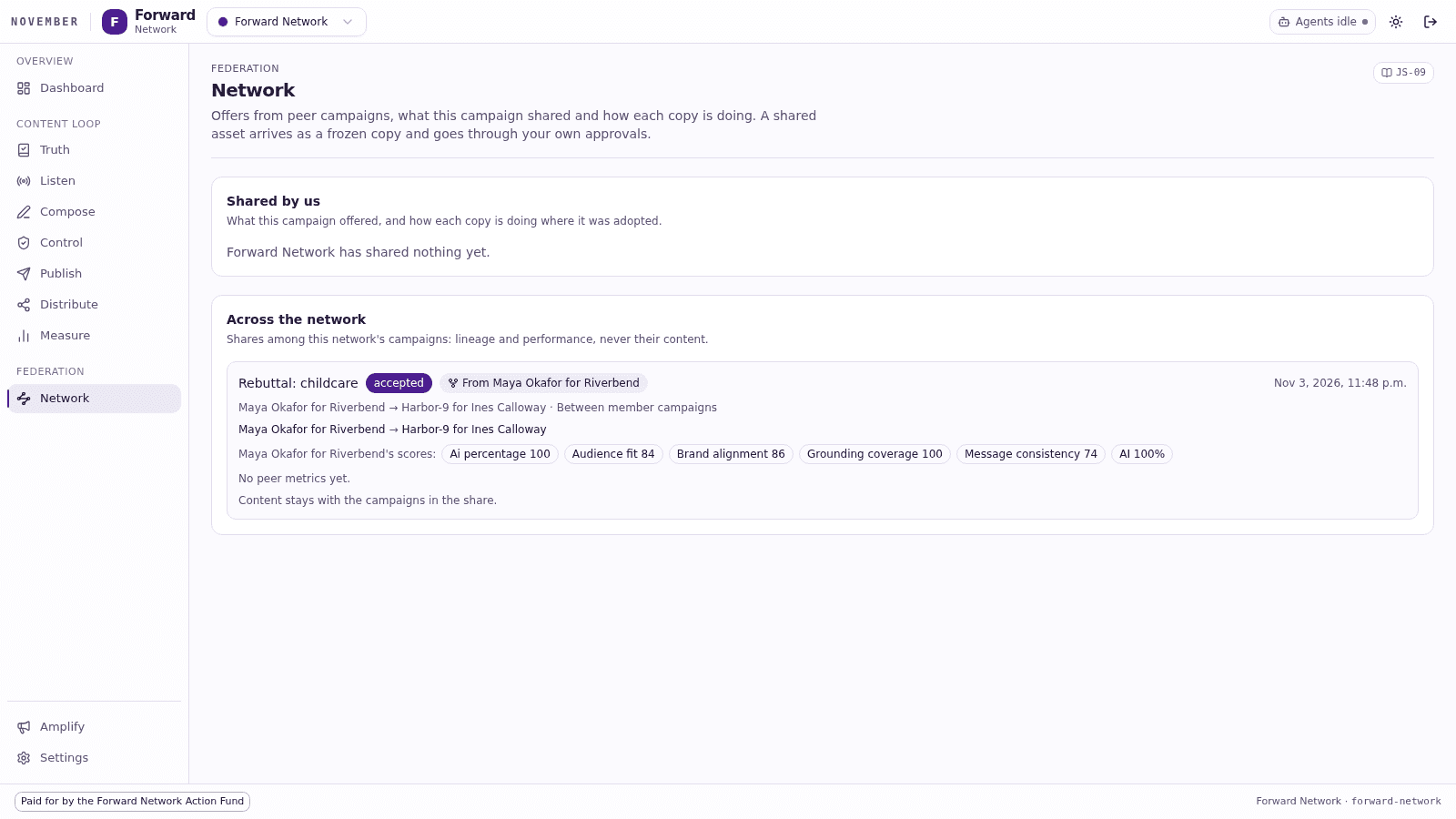
A national peer can follow what its campaigns share, so it can see what is working across districts, without holding anyone's material.
- The campaign that shared it
- Its own piece, where it was adopted, and how each copy performs.
- The campaign that accepted it
- A frozen copy with sources, scores and lineage, to edit and approve as its own.
- A national peer
- Who shared what with whom, the scores and the performance. Never the text.
A modern committee of correspondence
Before the American Revolution, towns and colonies formed committees of correspondence: independent local bodies that kept each other informed by letter. november gives campaigns the same arrangement. Each one governs itself, chooses what to send, and decides what to take.
Follow a rebuttal from one campaign to another
The demo is a working console for three fictional campaigns. Sign in, share a rebuttal from Riverbend-14 to Harbor-9, accept it there, and see what the Forward Network sees.