november keeps what the candidate has said, listens to the race, drafts cited responses, puts every one in front of the people who decide, and hands volunteers something true to share. Here is each part, with the screen it happens on.
Grounded truth
Every speech, town hall, interview and strategy meeting goes into one record, transcribed and split into what the candidate actually said. Each claim, commitment and position is pinned to the span of transcript it came from. When anyone on the team, or any agent, needs a fact, this record is the only place it comes from.
What your campaign gets
A searchable record of sources, claims, stories and positions
Every claim linked to the words and the moment it was said
Internal meetings kept apart from what can be said in public
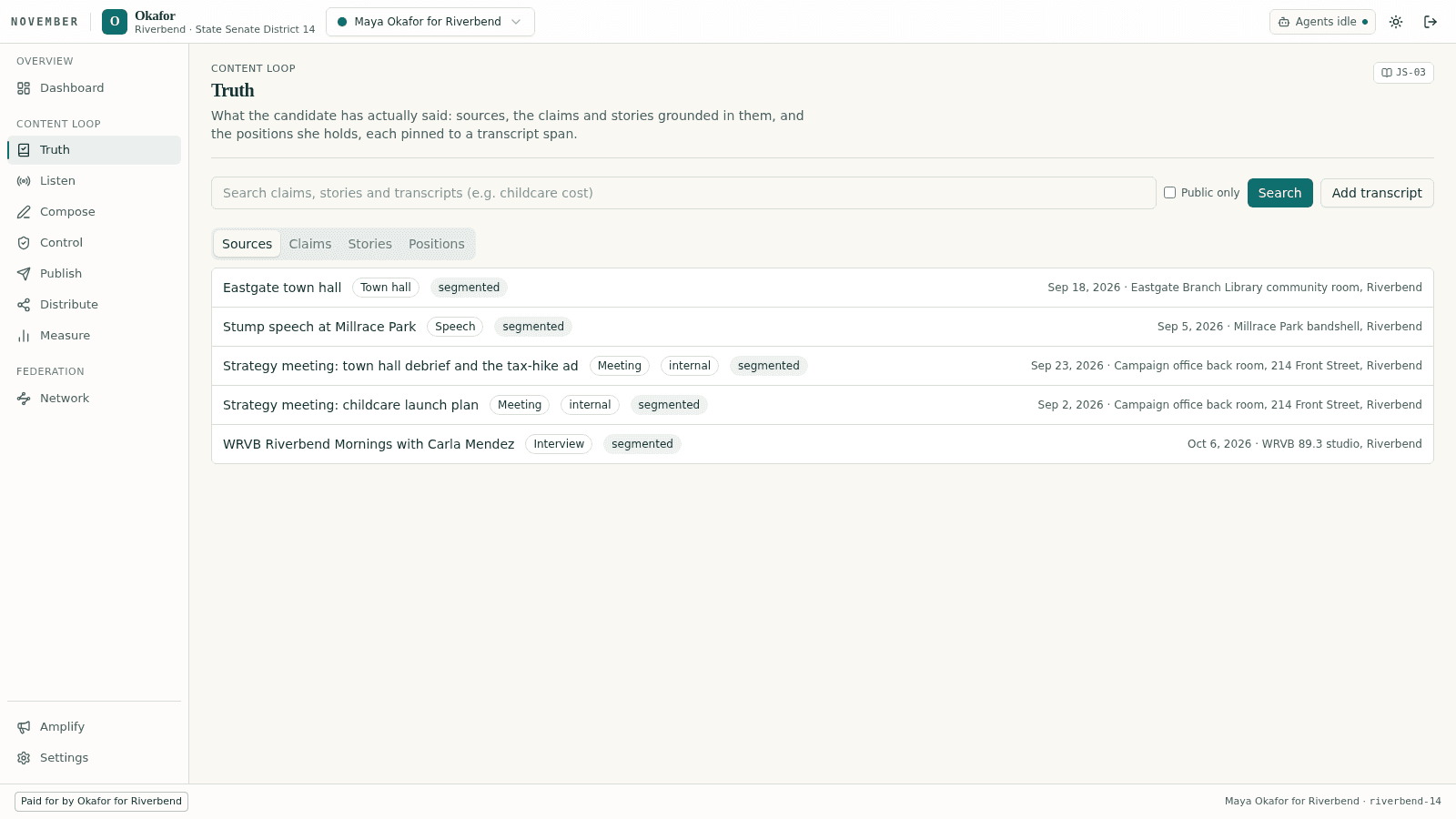
The record: every source the campaign holds, with where and when. Fictional demo world: candidate Maya Okafor, Riverbend-14.
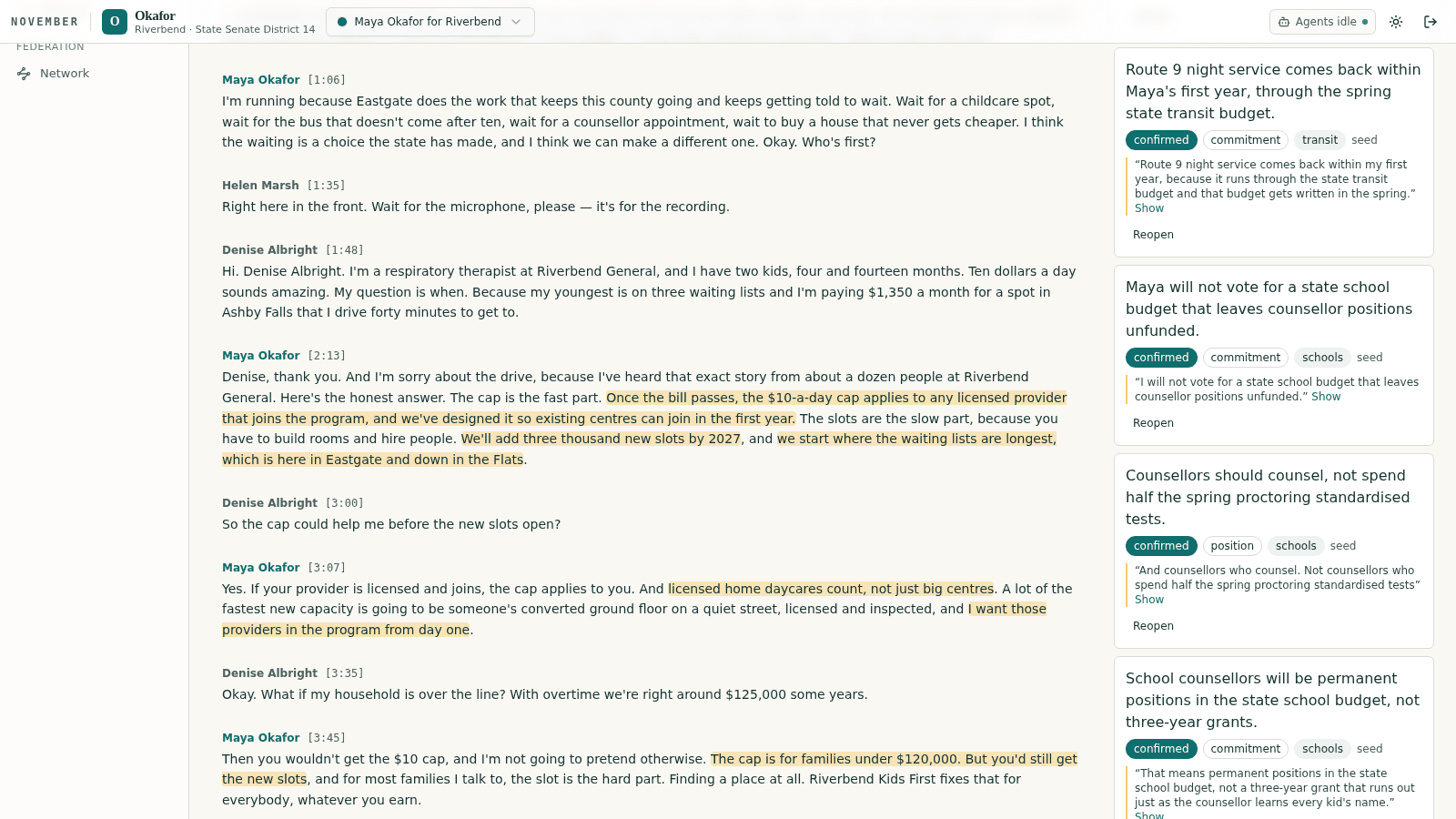
A transcript, with the claims drawn from it quoting her words. Fictional demo world: candidate Maya Okafor, Riverbend-14.
Listen and triage
november follows what the opponent, the press and voters are saying, and gathers it into clusters by topic and by who is speaking. Each cluster is ranked by urgency and comes with a suggested action, so the team decides what to answer from a short, sorted list instead of a raw feed. If the AI is paused, keyword triage keeps the queue sorted.
What your campaign gets
Signals from the speaker, the audience and competitors, side by side
Clusters ranked by urgency, each with a suggested action
One step from a cluster to a drafted response
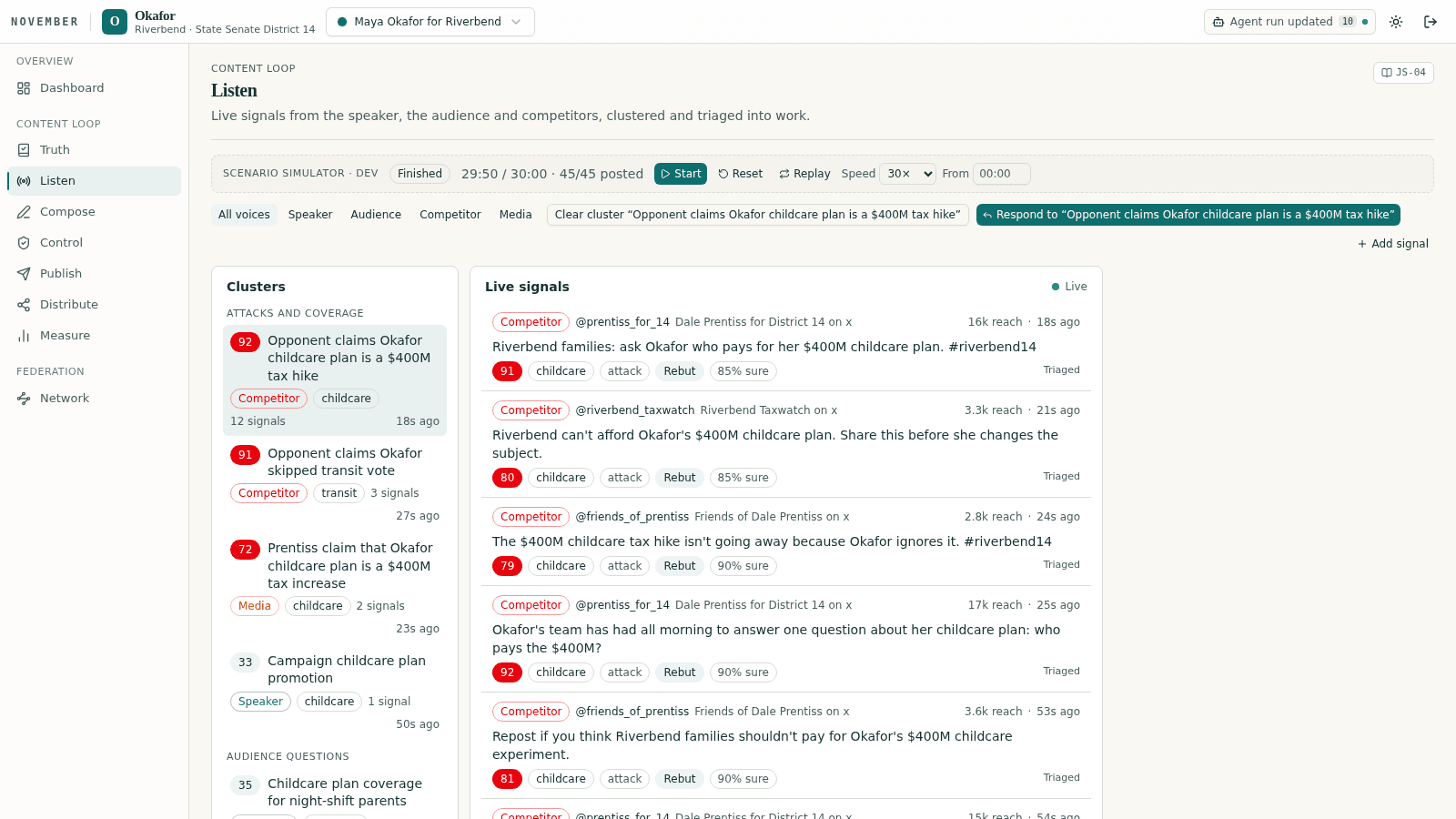
Posts attacking the childcare plan, gathered into one cluster with a way to respond. Fictional demo world: candidate Maya Okafor, Riverbend-14.
Respond with citations
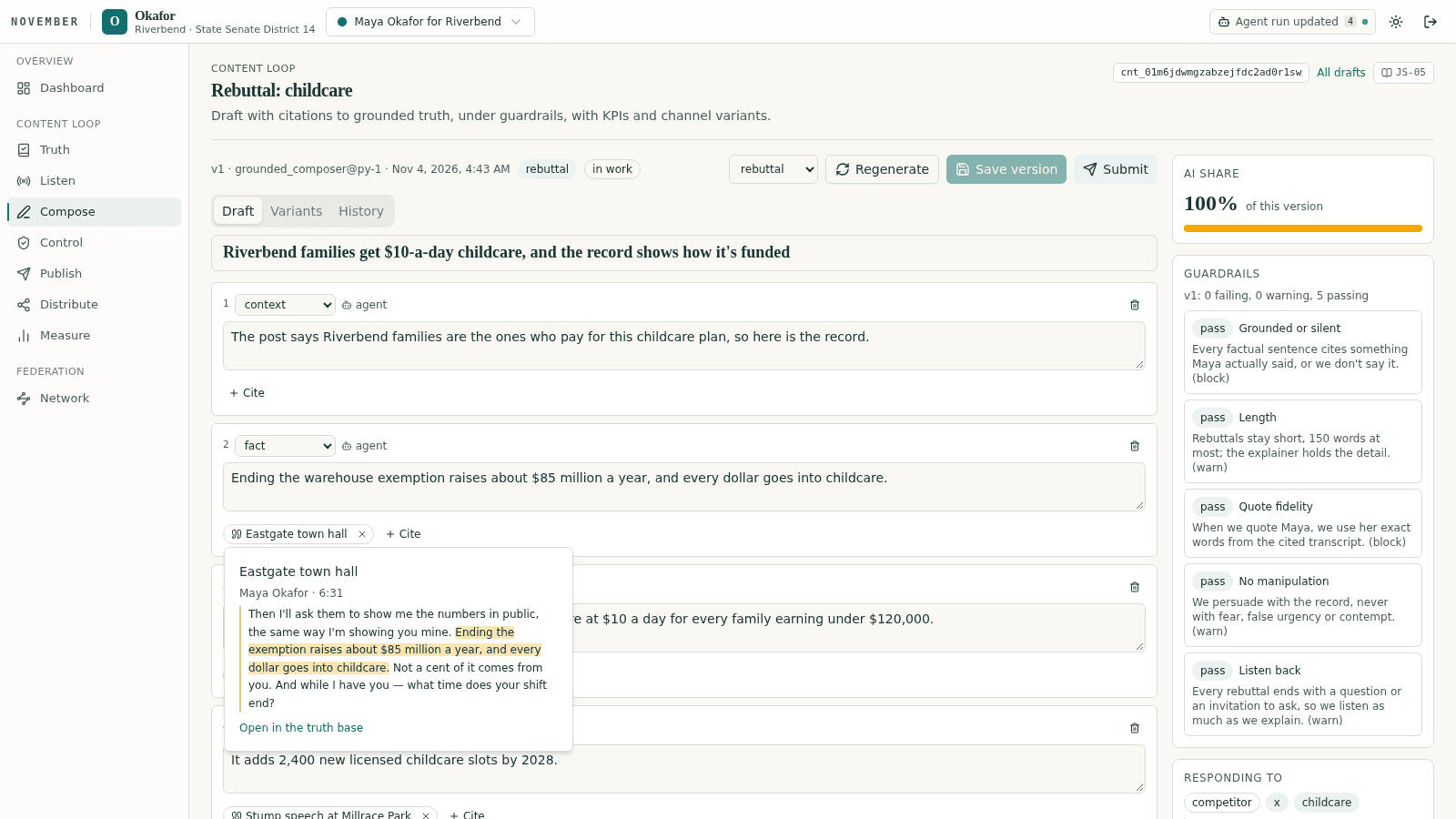
From a cluster, november drafts a response in the candidate's voice in minutes, sentence by sentence. Every factual sentence cites the transcript it rests on: open a citation to read her exact words, highlighted, with when she said them. Guardrails check the draft as it is written, and anything the record does not support is left unsaid.
What your campaign gets
A first draft in minutes, in the candidate's voice
A source behind every factual sentence, one click away
Guardrail checks before anyone is asked to approve
Channel variants written from the same text
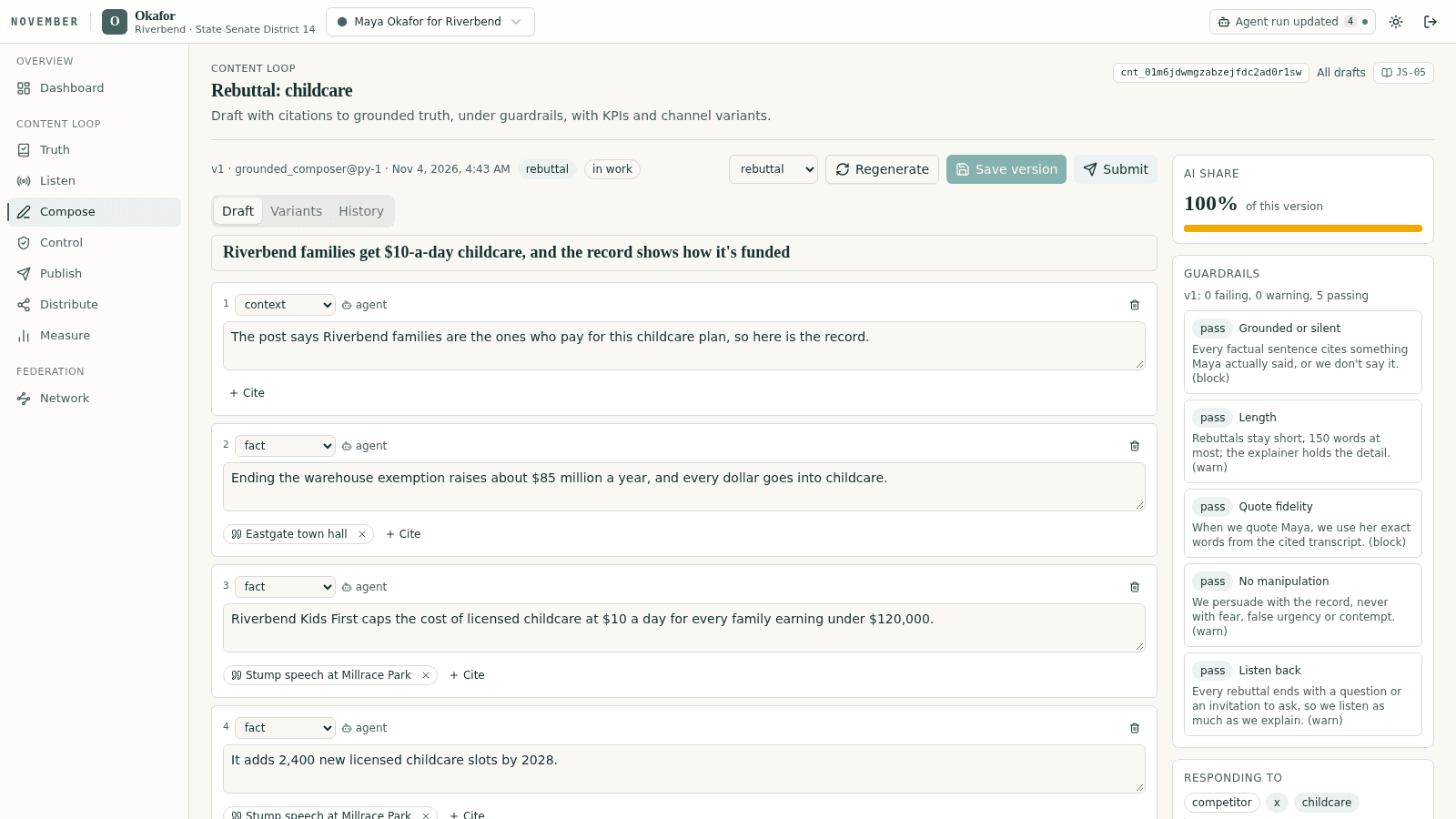
A rebuttal drafted sentence by sentence, with its guardrails alongside. Fictional demo world: candidate Maya Okafor, Riverbend-14.
Open a citation to read what she said, where and when. Fictional demo world: candidate Maya Okafor, Riverbend-14.
Control points: people decide
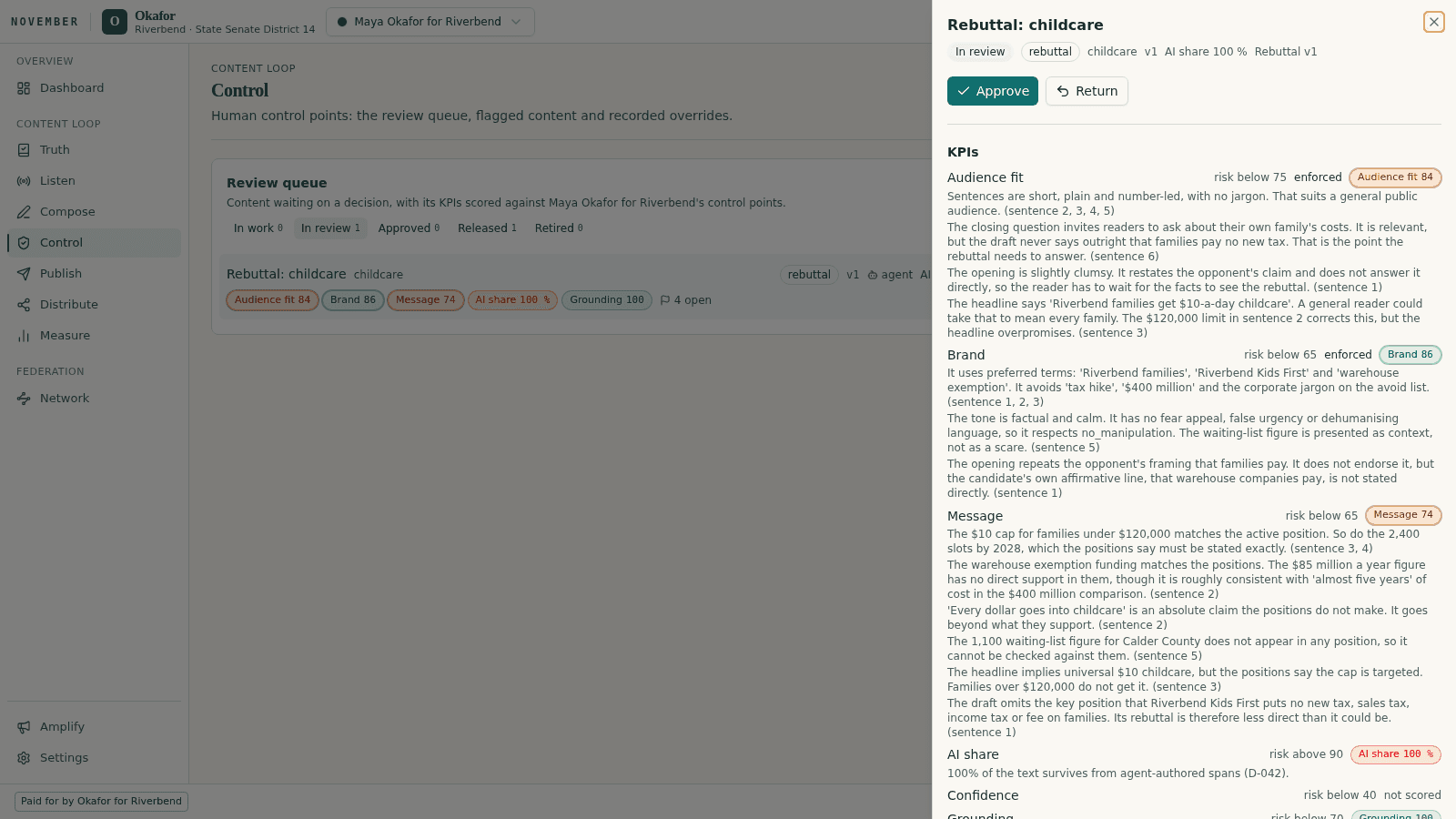
Nothing goes out because an agent decided it should. Every draft waits in a review queue, scored against the campaign's own KPIs (audience fit, brand, message, grounding, and how much of it AI wrote), and each score gives its reasons, sentence by sentence. Approval can require a second person, and every approval, return and override is written to an audit trail.
What your campaign gets
A review queue with KPI scores and the reasons behind them
Four-eyes approval where the campaign wants it
Thresholds the campaign sets, checked before release
An audit trail of who decided what, and when
A draft in review: every KPI score explains itself before anyone approves. Fictional demo world: candidate Maya Okafor, Riverbend-14.
Explainers for the doorstep
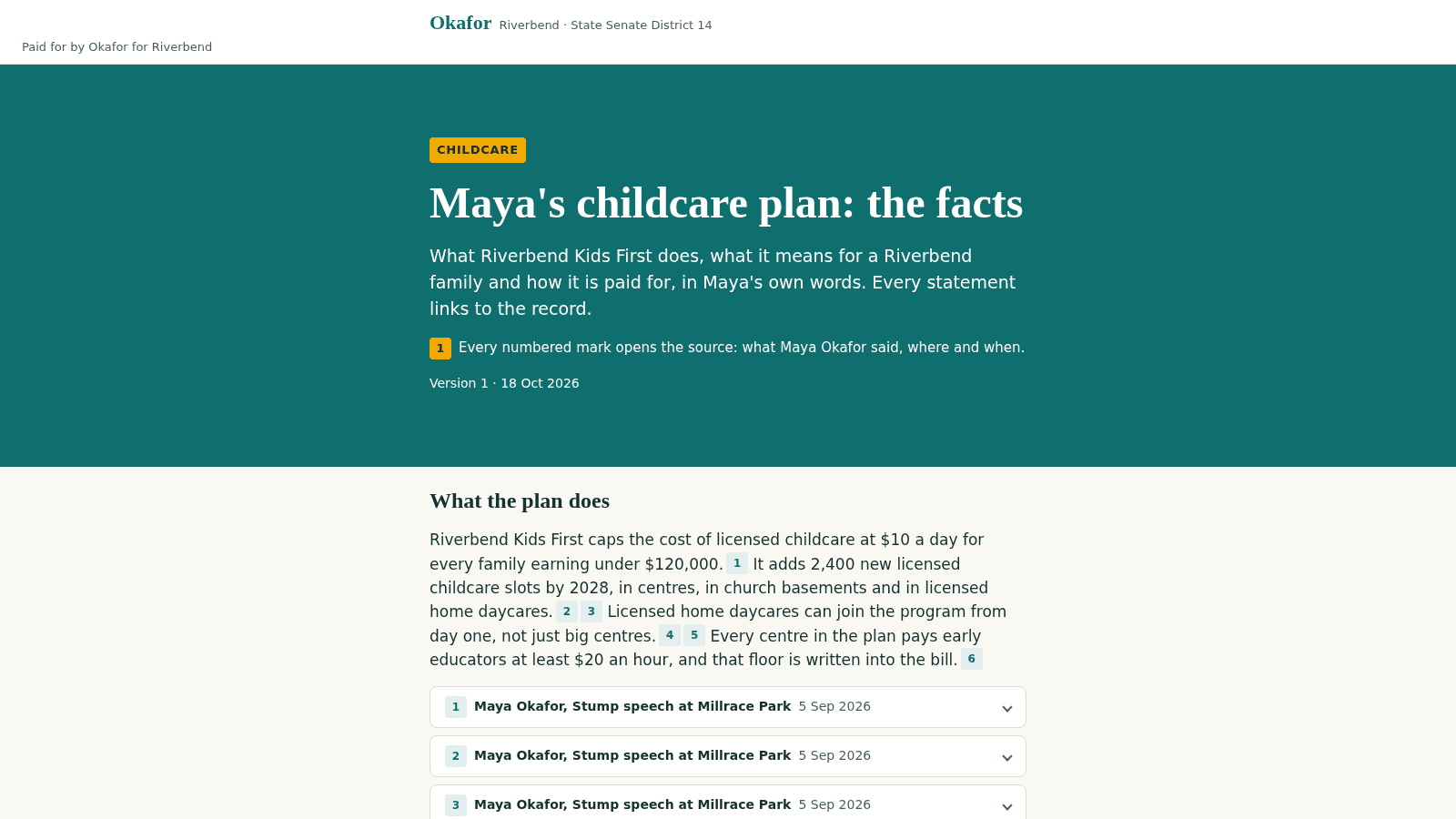
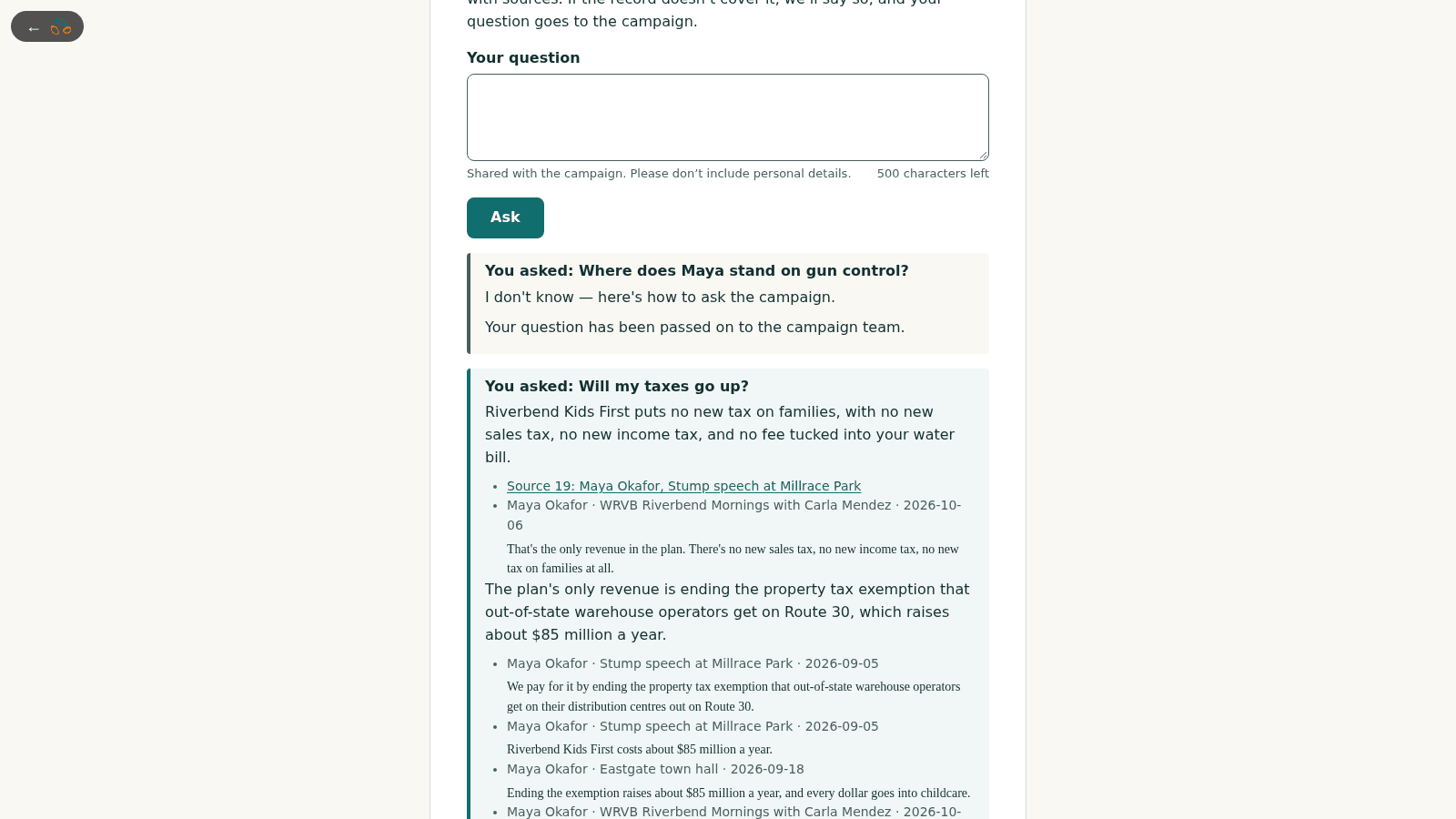
Approved material becomes a plain explainer page that a door-knocker can share with a QR code, and every statement on it opens its source. Voters can ask a question: november answers only from the candidate's record, with the sources. When the record does not cover it, the page says “I don't know” and passes the question to the campaign.
What your campaign gets
A phone-sized explainer page and a QR code for each topic
A mark after each statement that opens its source
Questions answered from the record, or plainly not answered
Unanswered questions sent on to the campaign team
An explainer: each statement opens the speech it came from. Fictional demo world: candidate Maya Okafor, Riverbend-14.
Asked something the record does not cover, it says so. Fictional demo world: candidate Maya Okafor, Riverbend-14.
Distribute: a kit for every volunteer
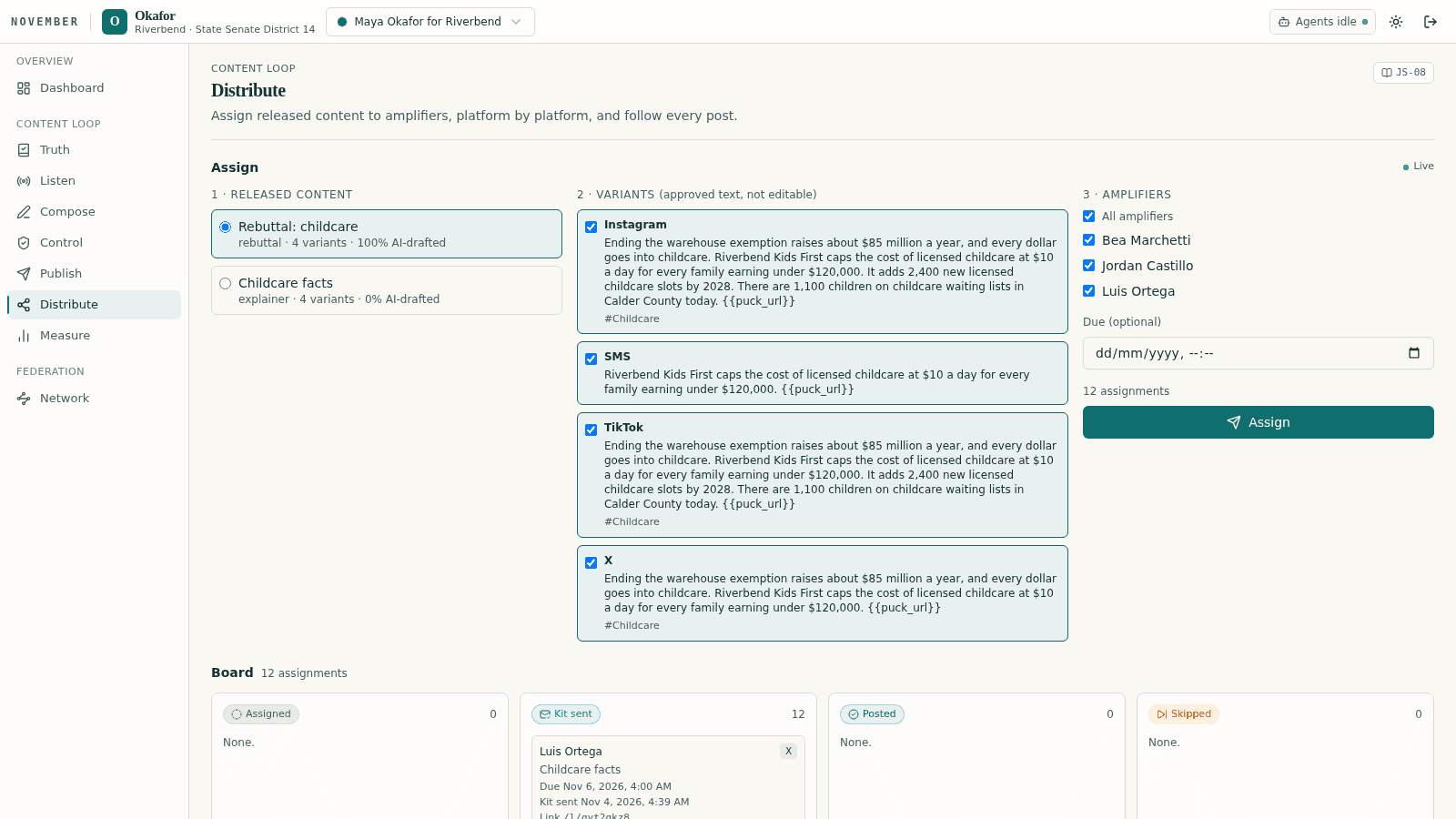
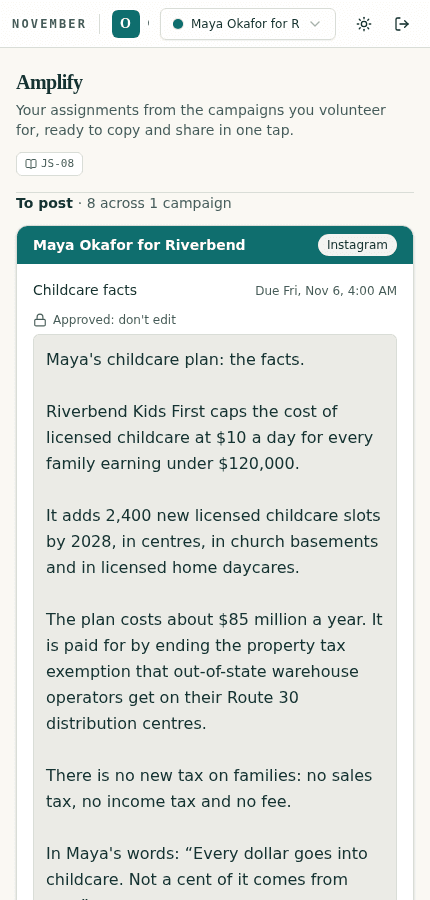
Released content goes to the campaign's amplifiers channel by channel, every variant taken from the approved text. Each volunteer gets a kit on their phone, ready to copy and share in one tap, and a board follows every assignment from kit sent to posted or skipped.
What your campaign gets
Assignments by channel and by person, with a due time
One-tap kits that keep approved text as approved
A board that follows every post
Released content assigned to amplifiers, platform by platform. Fictional demo world: candidate Maya Okafor, Riverbend-14.
The volunteer's kit, on their phone. Fictional demo world: candidate Maya Okafor, Riverbend-14.
Measure, and say where the numbers came from
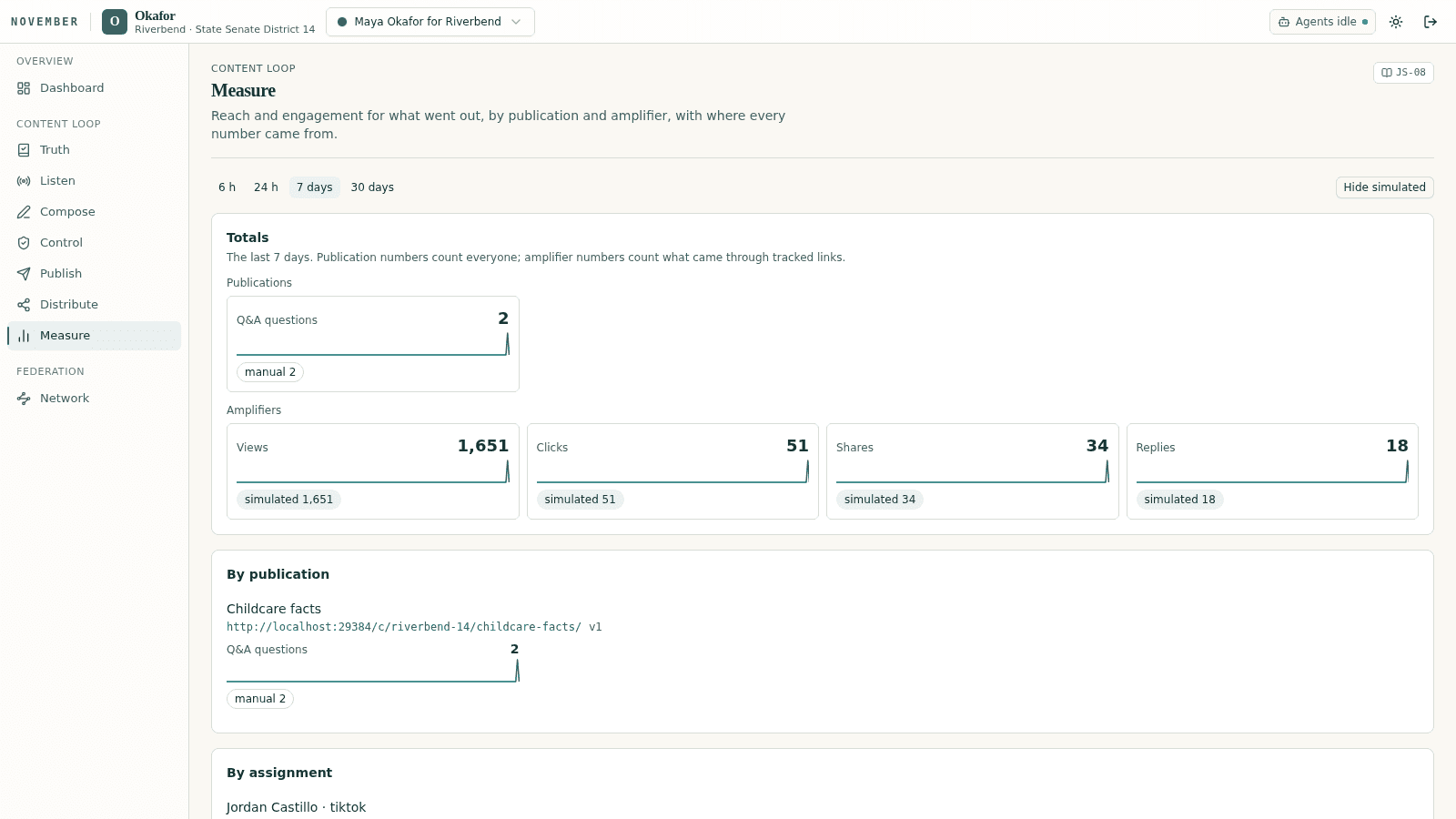
Reach and engagement are reported by publication and by amplifier, and every figure says where it came from: counted by november, entered by hand, or tracked through a volunteer's link. The demo's simulated figures are labelled simulated and can be hidden.
What your campaign gets
Totals by publication and by amplifier
The source of every figure, shown beside it
Questions asked on explainers, counted with the posts
Every total carries its source; the demo's figures are marked simulated. Fictional demo world: candidate Maya Okafor, Riverbend-14.
Federation: campaigns that share
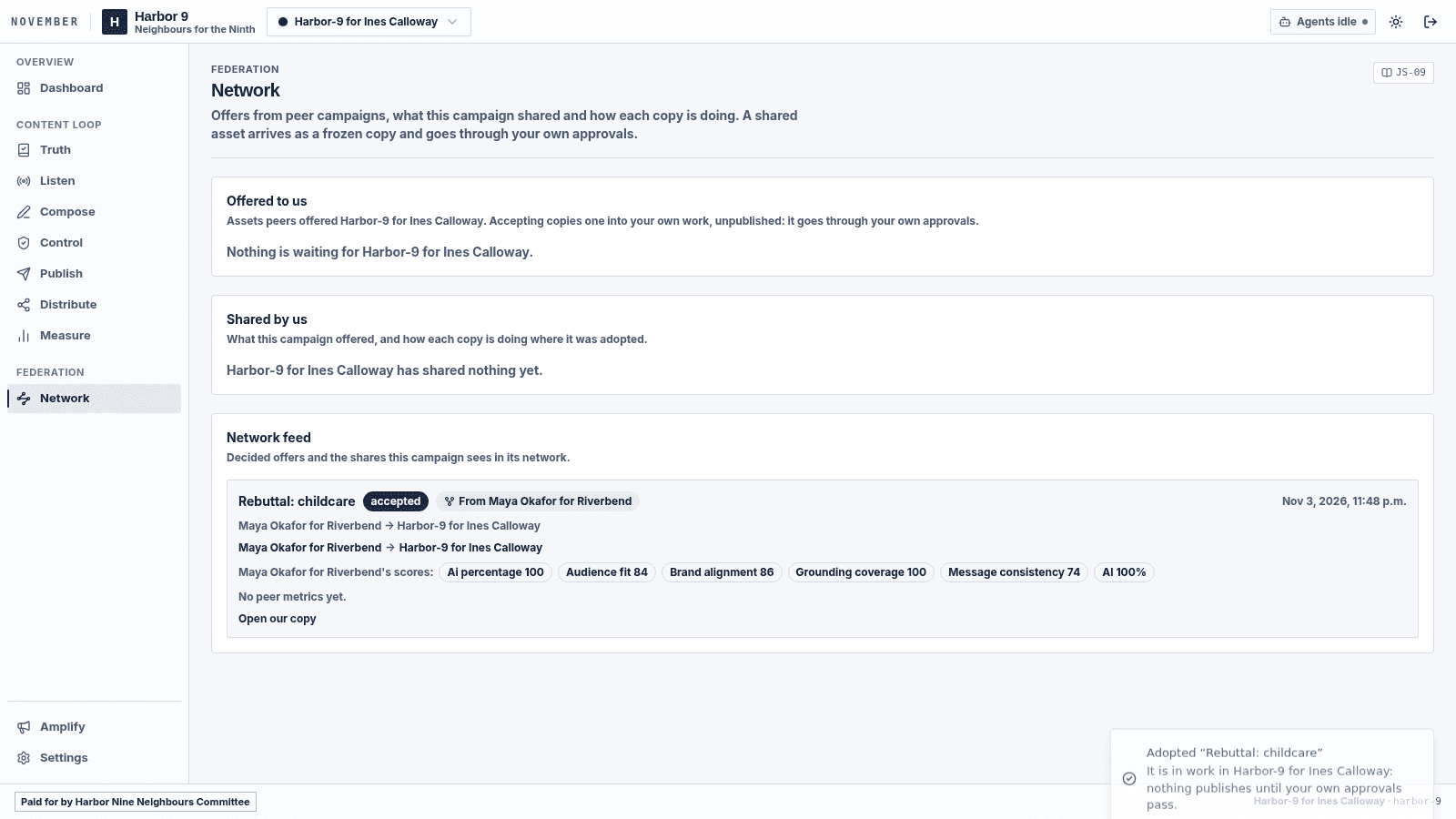
Each campaign stays sovereign, with its own record, its own people and its own approvals. A campaign can offer approved material to a peer it trusts, and the peer receives a frozen copy that publishes only after its own approvals. The network sees lineage, who shared what with whom, not the content.
What your campaign gets
Offers to and from the campaigns you choose
A frozen copy that goes through your own approvals
Lineage of every share, without opening your content to the network
Harbor-9, a fictional peer campaign, accepts a rebuttal from Riverbend-14; it still goes through Harbor-9's approvals. Fictional demo world: candidate Maya Okafor, Riverbend-14.
The story behind every screen
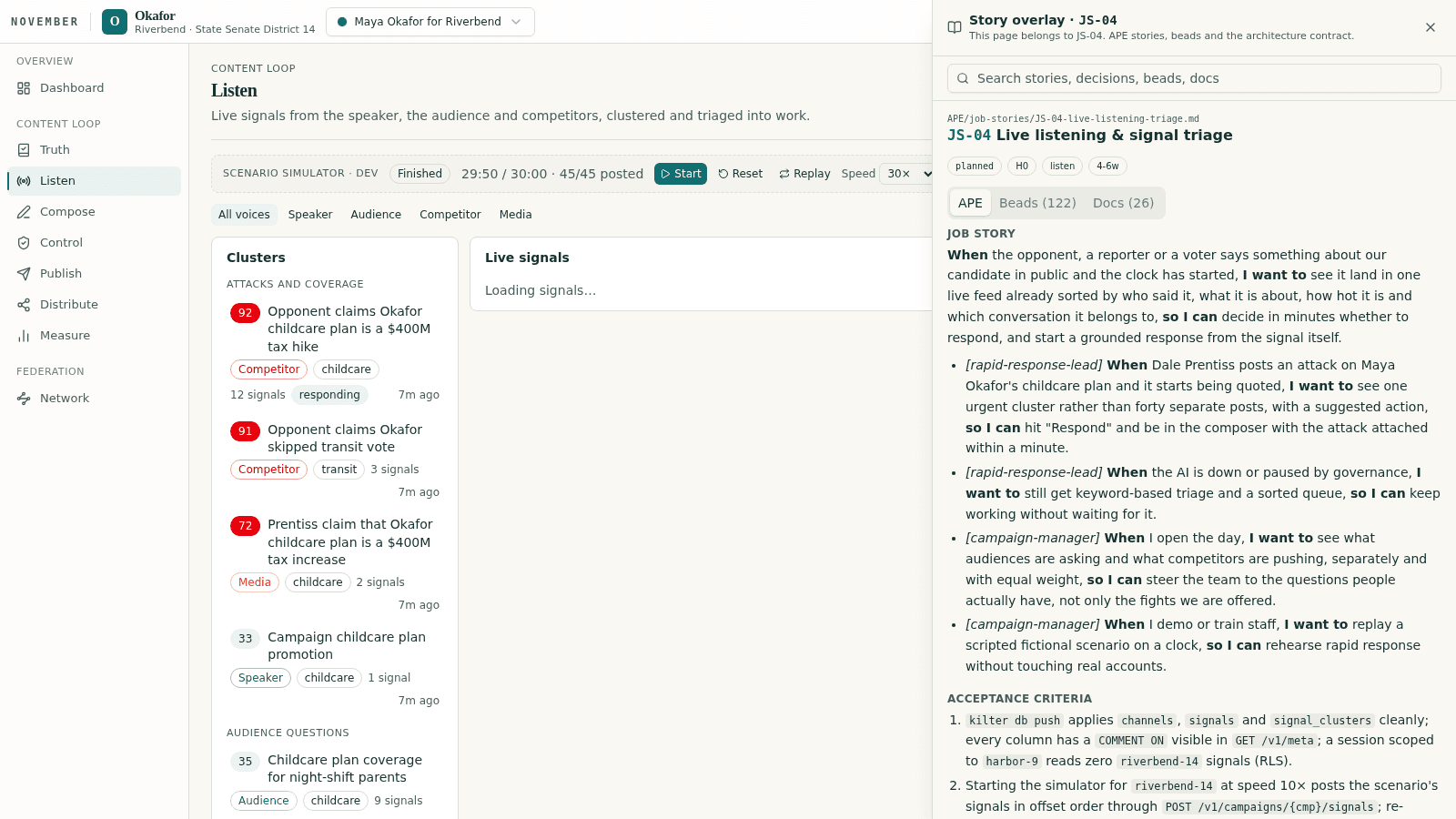
In the demo, every screen names the job it was built for. Open the story overlay to read the situation that screen serves and its acceptance criteria, so you can check the tool against what it was asked to do.
What your campaign gets
The job story behind each screen, one click away
Its acceptance criteria, in plain language
The story overlay, open on the Listen screen. Fictional demo world: candidate Maya Okafor, Riverbend-14.
See it work on a campaign
The demo is a working console for a fictional race. Sign in and follow one response from the candidate's record to a published, cited answer.